Bread & Circuses
The Price of Entertaining Mexico
It was one of those mobile Barnum and Bailey-type venues that at one time caused people to bundle their kinfolk into wooden wagons and search for electric sermons in the rustic reaches of America. A century ago tent revival meetings were popular. Many considered them the moral calisthenics of a healthy soul. Others just saw them as entertainment, an agreeable way to spend a Sunday afternoon. The smell of straw, warm canvas and stabled animals were all part of the ambience. Today, most of these elements have been replaced by diesel rigs, trailers, pickup trucks and cars.
There had been no leaflets or flyers advertising this particular event, just a slow-moving ball of dust with a car at its nucleus, shrilling hyperboles from a bullhorn mounted on its roof. If you didn't understand Spanish you were invited to stare at your feet in bewilderment.
Open-air speakers had been mounted at the ejido’s soccer field, about five miles north of San Felipe. By late afternoon they were reverberating boasts and superlatives that belittled every other form of entertainment in the Republic. The doors were scheduled to open at eight o'clock that evening. A half hour before show time, semi-regular bulletins began counting down the minutes.
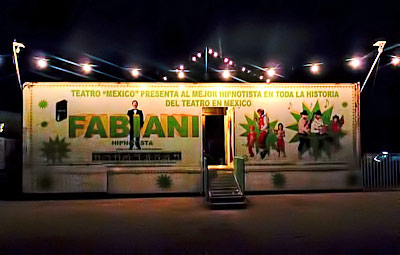 Seven minutes before time’s arrow reached the target, I fetched my camera and sallied down to the big tent, which was only a short walk from my residence. There was a solitary pickup truck parked about ten yards from the venue’s flamboyant trailer. Two young Mexicans, painted by shadows, stood beside the rear fender. They were passing a delicately smoking doobie between themselves, aka weed or more locally, mota (the nose has its own in-built spectrometer).
I asked them where all the people were. "Adentro", came the reply. I took a few photographs of the trailer's art work and walked up the entrance ramp. An announcement said there were three minutes left and urged everybody to purchase a ticket while they still could. Presumably after three minutes everyone’s arms would suddenly become too short to reach their wallet.
Twenty pesos bought me passage past a swarthy Whistler's grandmother in a straight-back chair. I stepped into a capacious blue tent, relaxed into long, languid swags over a Rubik of metal poles, cables and ropes. A hundred militarily aligned chairs focused on the jutting jaw of a small green stage, partially veiled by a lurid red curtain. Perhaps fifteen people formed a tiny hive of animated heads and voices near the center of the phalanx.
I sat quietly at the sinistral extremity, a castaway on a raft of empty chairs, and for five minutes listened to ranchero music stampede from enormous speakers on either side of the stage. Suddenly a bass fiddle voice mercifully, but only briefly, interrupted the rustic aria to assure us of imminent entertainment.
Five minutes later the announcer swore a sacred oath that Mexico's most memorable and unrivalled theatrical spectacle would commence in thirty seconds. Meanwhile two small children had been ritually interloping, entering from the trailer door and walking up the aisle, mounting the stage, then ducking behind the curtains. They did this several times. Finally, after a tremendous fanfare from the self-important speakers, the curtains parted and the same two children stepped out, the girl now dressed as a suburban adult with lips as red as begonias.
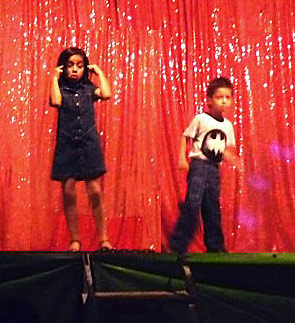 A painfully loud Mexican ballad brayed from the nervous sound system and the girl, perhaps six or seven years old, began lip-syncing the words of the song. The lyrics decried her unhappiness with her husband. She didn't love him anymore. She was tired and fed up with their marriage. Then, to my astonishment, she began to bitch slap the little boy all over the stage. She reached out and yanked his hair, twisted his head like a radish on a stem, and cuffed him mercilessly. The boy was utterly stoic throughout the ordeal. The audience was delighted.
Much of the song was unintelligible to me, and I was grateful for that. There was something haunting, even harrowing, in the way the girl portrayed the shrill harpy. The manner in which she was able to distort those little ruby lips of hers into a series of loathsome grimaces was truly frightening.
When the song was over and the two players made their exits through the florid curtains, the girl gave the boy a tremendous kick in the middle of his back, which transformed him into an anatomical pinwheel as the fabric closed behind them.
There was a longish high decibel interval before the next act appeared. A mature woman stepped through the curtains with a microphone. She was followed by a tiny girl, perhaps four years old. As the woman began to speak, a sudden voice thundered from behind me. It came from the entrance and I turned to see a man slowly walking up the aisle. He wore a multicolored hat and shirt, a large red tie and scarf, a red nose and the outline of a white deflated tire around his mouth, all the conventional symptoms of a clown. The loutish Punchinello climbed onto the stage to join the woman and child.
As the two adults began to banter the woman announced she was wearing a variety of perfumes. The man expressed a desire to sample one. She offered her hand and he sniffed her wrist, rolled his eyes and waxed euphoric about the aroma. He asked what it was called.
"Forty lights in the heavens," she replied, or some such grandiloquent name. He lifted his own hand and told her to inhale. She breathed and her face pinched into a scowl.
"What do you call that?" she complained.
"One hundred pounds of pinto beans in a canvas sack," he replied.
 The two proceeded to smell various parts of each other's anatomy, the woman associating her fragrances with poetic-sounding labels such as "Evening Song Bird" or "Angels' Breath" while each time, in response, the clown attached his own odors to names like, "A pail of Malecón fish heads."
They made their way down to the groin area and he turned his back on the audience, told her to smell his. He promised it was very special. When she tentatively approached, he grabbed her by the hair and pulled her head down to his pelvic region. The audience howled.
Another interlude of stentorian music separated us from the next act. Finally a man with a greasepaint moustache and sideburns ambled through the curtains and placed a small green accordion at center stage. He wore a cowboy hat, carried a stringless banjo and grinned like a village idiot. Then the boy who had suffered the fury of his 'wife' in the first act appeared, holding a toy electric guitar. The music began to squawk as they both jumped like sand fleas, mimicking yokel musicians. Suddenly another man, balanced under a fright wig and straw cowboy hat, joined them. This one held a battered guitar, also without strings. The two men mouthed the lyrics as they pretended to play their faux instruments, sometimes speeding up to follow the increased tempo of the recorded song, sometimes slowing down to glacier motions as the music distorted to a garbled crawl. At odd intervals the little boy would walk behind one of the men, reach up through the adult’s spread legs and grab his penis, or send the neck of his toy guitar arcing up between the man's legs. Occasionally one of the men would bend forward in time to the music and mime, with an elevated leg, a trumpet of recorded flatulence.
In ancient Rome, playwrights had to please the roughest and very probably, the most stubborn audiences in the history of live theater. Spectators were chiefly men of low social standing. Very few were native citizens. Most Romans were serving abroad as soldiers or colonists as Roman cities became filled with rustic riffraff, strangers, uncouth barbarians, prisoners of war, and freedmen. They were an ignorant and brutal lot, knowing just enough Latin to make it the lingua franca. Any delicacy or subtlety of form was wasted on them. No jest was too gross or too violent to amuse these brutes, whose principle entertainment was the blood sports of the arena. They were uneducated people with uneducated tastes.
Today, with so much historical distance between us and the ancient Roman Republic, one hopes for a certain amount of decorum in public entertainment, if only to insulate the very young from an early indoctrination into the baser flavors of our 'civilized' palette for amusement. And really, it is the very young who pay the price for this kind of entertainment. They are pressed into service and often enact scenes and spectacles that are more properly the domain of people who should be serving as moral compasses. The truth is, rural entertainment in Mexico pretty much adheres to the ancient Roman formula. In a culture oppressed by corruption at every level, where the population is aggrieved by monopolistic service cartels that control electricity, water and communications and do not provide even the meagerest level of support or quality, Roman bread and circuses would appear to be the appropriate fare for their intervals of leisure. But is it necessary to conscript children for such diversions?
A common sight at our local Carnaval parade is a queue of minikin five-year-old girls dressed as Vegas dancers, bumping and grinding to erotogenic music. Sexualizing children is a policy that generates a number of serious social problems, the worst of which is an increased interest in pedophilia. A litmus test applied to very nearly any Mexican town will render a positive reading for the presence of child pornography and pedophilia. Even San Felipe has, per capita, offered up a rather startling number of transgressors. Sadly, very few were introduced to the inside of a penitentiary. There are just too many slippery loopholes and weak links in the web of Mexico's judicial system. Most apprehended predatory fish wind up in some other pond where they are free to molest fresh, unsuspecting minnows.
In countries where third-world veneer-democracies are overlaid on foundations of despotism and education habitually washes the feet of dominant 'party lines', corrupt nepotistic legal systems often blunt the teeth of local justice. This creates fertile fields for sexual predators searching for a place to sow their crimes. Mexico has long been a haven for them.
Mexico has a history of protecting its rotten apples. And owing to the country's strong links to the Vatican, this protection has become fortified by the Church's rigorous indifference to its own culpability. Like Nixon, the Church assumes an above-the-law stance, practicing unilateral judgment of its own numerous transgressors. In 2002, John Paul mandated that all charges against priests were to be reported secretly to the Vatican and hearings were to be held in private, away from any press or public attendance, a procedure that directly affronts state criminal codes. Rather than being defrocked, many exposed pedophilic priests are advanced to well-positioned posts as administrators, vicars, and parochial school officials. Despite being repeatedly accused by victims and their families, the Church's felonious subalterns have been routinely promoted by their superiors.
Take the case of Rev. Nicolas Aguilar-Rivera of the Tehuacan diocese, a priest now in the wind and on Mexico's federal most wanted list. In 1987 Aquilar-Rivera was attacked at his parish, probably a direct reply by one of the congregants to his pedophilic activities, and was consequently relocated by his superiors to an East LA parish. After just a few months, he was again reassigned to a South Central Los Angeles parish, likely in response to his sexual proclivities. In December of 1987, two young men informed their parents of the priest's sexual misdeeds. The parents reported the incident to the archdiocese. The Church did not inform the local police, but rather confronted Aquilar-Rivera in private. The priest fled to Mexico. One of the young men, Joaquin Aguilar Mendez, secured lawyers who filed a lawsuit against Cardinal Norberto Rivera Carrera, the powerful head of Mexico City's archdiocese. The lawsuit accused Carrera of conspiring to protect Nicolas Aguilar, in response to letters written by Mendez and mailed to both Nicolas Aguilar and Carrera. Since 1987, there have been at least 60 testimonies against Aguilar by children aged five to thirteen.
"We hope this will inspire more Mexicans to overcome their fear and denounce their persecutors," said Eric Barragan, a spokesman for SNAP (Survivors Network of those Abused by Priests), which sponsored the lawsuit. The group was formed in 1989 and opened its first office in Mexico in 2007. Since then it has identified at least 65 priests in Mexico involved in sexual offences, none of whom have gone to prison. More than a hundred priests in the US who have been accused of molesting kids have fled to Mexico. If this isn't an endorsement of Mexico's acceptance and tolerance of the sexual abuse of children, what is?
Fear of consequence dogs the citizens of Mexico and even today many or most sexual abuse crimes go unreported. When there is a vast distance between social accountability and judicial redress, who you know becomes more important than what you've done. Damaging acts of irresponsible self-gratification become lacunae within the culture's social diary, redacted by corruptible power brokers or made invisible by the hidden hands of influence. For those who attempt to expose these vices, as in the case of Mexican journalist Lydia Cacho of Cancun, arrests, death threats and assassination attempts become familiar companions.
Mexico has been a member of the United Nations for almost 70 years. The UN's Convention on the Rights of the Child, which came into effect in 1990, would appear to reside inside one of Mexico's many moral blind spots. Although Mexico has joined a long list of nations that have ratified the document, the country's uncritical devotion to the Church provides a comfortable level of impunity for its ecclesiastical sex offenders. Interestingly, the USA is not among the 194 countries that have ratified the convention. They are allied with Somalia on that account.
The sucrose that attracts the rapacious pedoflies to Mexico is undoubtedly the nebulous quality of the Republic’s jurisprudence. Like a mirage over hot sand, it is difficult to molecularize any statute into sharp focus. Grey areas and loopholes litter the dry expanse of Constitutional law. One legislation always seems to contradict another, and it often seems a ruling is merely a matter of disposition or mood, at best, or the result of the time-honored incentive of mordita, at worst. When you add to this the destabilizing effects of almost constant law reforms, cultural culpability becomes only theoretical, impossible to enact for the same reason physic’s principle of complementarity is impossible to resolve.
Extra seasoning is thrown into the goulash with Mexico’s tendency to recognize tradition and custom, --the rules, principles, and norms formed along a gradual but uniform passage of time.
The rock of tradition has always been too burdensome for a child to carry. But because adults revere its weight and believe it is in the best interest of a culture to entrust this outdated baggage to their offspring, they make a gift of the payload. Unfortunately this benefaction attaches a number of cobwebish attitudes to itself. For example, in most Mexican states, the written and unwritten legal age of sexual consent is 12 years.
In the Republic, victims have only six months in which to report sexual abuse crimes, another tacit acknowledgement of the country's tolerance for pedophilia. And legal changes that benefit individuals appear at continental tectonic paces. For example, the state of Jalisco only recently raised its age of sexual consent from 12 to 15.
The sad fact is that Mexico’s populist-level amusements dovetail nicely with the country’s reputation as a safe house for pedophiles. Preconditioning children to mimic actions of social reprobates only dilutes their future response to aberrant experiences. It is easier for them to accept the unthinkable actions of a pedophile if they have been previously introduced to overlapping sexual motifs.
Mexico’s recreational choices are engineering a generation of Rabelaisian children, existentially jaded by the time they are touched by the fatherly hands of their priests. Billing this process as ‘the greatest entertainment in the Republic’, or ‘unrivaled amusement’ only boot-straps and self-feeds the industry.
If the criterion for what constitutes inappropriate behavior toward a child is not part of a school’s curriculum, then Mexico’s youth will certainly become educated in the other direction by what passes as public diversion.