Art for Art's Sake
Van Gogh died in poverty. The highest price he fetched
for one of his paintings was $17. A hundred years later
a Japanese businessman paid $82,500,000 for van Gogh's
Portrait of Dr. Gachet.
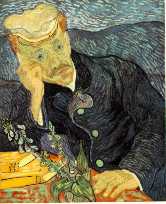 Of
course everyone has heard of Vincent van Gogh. He's
been at the hub of the Impressionist Movement for generations.
His paintings are valuable because wherever there's
a wholesale focus of attention on something, the specter
of money is always nearby. So I was more than surprised
the other day to see an unsigned painting by an unknown
artist worth in the neighborhood of fifty million dollars.
The painting was leaning on an easel in front of a real
estate office in San Felipe.
Of
course everyone has heard of Vincent van Gogh. He's
been at the hub of the Impressionist Movement for generations.
His paintings are valuable because wherever there's
a wholesale focus of attention on something, the specter
of money is always nearby. So I was more than surprised
the other day to see an unsigned painting by an unknown
artist worth in the neighborhood of fifty million dollars.
The painting was leaning on an easel in front of a real
estate office in San Felipe.
There was no price tag on it. I only
discovered its value when I went inside the office and
learned it was an artist's rendering of a future condominium
complex to be located south of town. The man who told
me this had eyes that flicked about the office like
a frog tagging houseflies with an especially adhesive
tongue. He was middle-aged, high-octaned and had a thick
thatch of hair that hung in layers from the crown of
his head. It made him look like a palm palapa on a moonless
night.
By the way, before entering the office
I noticed an ornament on the window ledge, a squat sand-filled
vase whose flower was in full bloom, a bouquet of cigarette
butts. I’ve come to learn that such a bouquet
is the natural spore of real estate people.
The man who accosted me when I entered
the office was a member of the nomadic realtor tribe
that had recently discovered San Felipe was secretly
wedded to the holy grail of their marketable resort
profile, a profile well proven to be as lucrative as
sharing DNA with a Rockefeller.
Resort-building real estate people all
seem to share the same lexicon, the same disinterest
in local history and geography, the same sign painter
and the same desk, where they sit with one hand in a
box of superlatives, ready to confetti the head of anyone
who crosses their threshold.
Nomadic realtors often partner with neon-lit
developers who dash about like dogs in a sniffing fever,
scenting their land with power poles, billboards, metal
coyotes and cement fountains. These developers are usually
once-removed from public contact but like the real estate
agent, they will do their best to fling verbal confetti
when cornered. And of course, both silently celebrate
the uninformed buyer.
I quietly sat in that office while the
unending superlatives hailed about my ears. And although
it required a certain amount of spears and shield tactics,
I learned there was no condominium building. Nothing
existed off the artist's canvas that echoed its color
and lines. There was an empty expanse of sand near the
sea where a few large earth-moving machines droned up
and down between surveyor's pins. I was asked to image
the building was actually there, my condo readily accessible.
I was given a cerebral tour of my apartment, presented
the incomparable vista with a sweep of an arm. I was
even told what I would be doing with my evenings when
I lived there. And since the mind always confuses the
thought with the thing it represents, it was easy to
see how people could be swayed to sign papers in exchange
for an hour of confetti and an ocular tour of an artist's
depiction of the proposed project.
Once or twice I managed to coax a double
dose of confetti from the salesman with the mention
of a key word or phrase that obviously triggered a programmed
response. It was like watching a Carmelite whipping
himself into a lather of atonement. One of the words
was fideicomiso. Another was Title Insurance.
A third was notario.
I must have absently nodded once because
a paper-clipped manuscript suddenly appeared under my
nose which I was expected to sign. The paperwork represented
a series of strings that were engineered to legally
extract $300,000 from me. The real estate man seemed
unconcerned I lived in a trailer and that it would take
me one hundred years to save that amount of money. To
him the amount was a single brush stroke against the
canvas on the sidewalk outside his office.
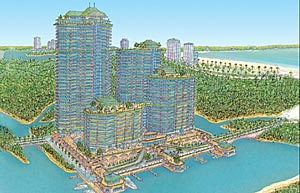 Scores
of real estate venues have appeared in San Felipe. They
all have artist's renderings of various condominiums,
track homes, gated communities and golf courses. Each
painting represents millions of dollars to its owner.
And somewhere in basement studios around the globe,
the artists are furiously dashing them out, receiving
their modern-day equivalent of seventeen dollars for
each one.
Scores
of real estate venues have appeared in San Felipe. They
all have artist's renderings of various condominiums,
track homes, gated communities and golf courses. Each
painting represents millions of dollars to its owner.
And somewhere in basement studios around the globe,
the artists are furiously dashing them out, receiving
their modern-day equivalent of seventeen dollars for
each one.
Meanwhile, throughout the turbid activities
of the real estate people and the developers, the desert
and mountains suffer the silliness with stoic grace.
They know the security of longevity which elegantly
outlasts fideicomisos and title insurance.
They have staked their claims in the geological vastness
of the planet's diurnal clock. They are patient, which
is the perfect antidote for today's local climate of
impatience.
Of course I left without signing anything.
It's sad that many people do not. They unfortunately
confuse a real estate salesman's passion for money with
an enthusiasm for an unsubstantiated building project.
It can't be too tragic though. If you look west you
can see the mountains smiling. Or maybe it's just they
way Darwin's shadow hangs across them.